

How Much Screen Time for Kids Is Too Much?
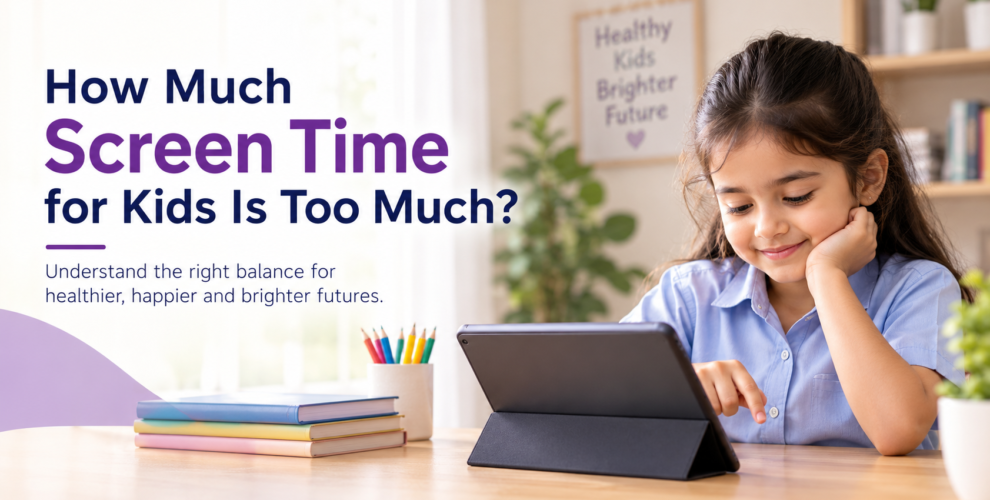
Your child finishes homework, picks up a phone to watch just one video, and suddenly an hour has passed. Sound familiar? You ask them to put the phone away, only to hear, “Just five more minutes!” If this happens in your home, you are not alone.
Smartphones, televisions, tablets and computers are now part of children’s everyday lives. Screens can support learning and entertainment, but when does their use become too much? Are they taking time away from outdoor play, sleep, reading or family conversations?
As parents, we don’t necessarily want to ban screens. We want our children to use them wisely. So, how much screen time should kids have, and how can you find the right balance for your child?
How Much Screen Time Should Kids Have by Age?
There is no single screen-time rule for every child. Age, content and daily routines all matter. However, these general guidelines can help you decide what works best for your family.
| Age Group | Guidance for Recreational Screen Time |
| Under 2 years | Avoid routine screen media; video calls may be an exception. |
| 2–5 years | Aim for no more than 1 hour daily of high-quality content, ideally with a parent. |
| 6 years and older | Set age-appropriate limits that protect sleep, exercise, study and social interaction. |
But here’s something worth asking yourself: Is your child using screens for learning, or mostly for entertainment?
A child attending an online lesson has different needs from one watching short videos for hours. Instead of focusing only on the clock, look at what screen time replaces in your child’s day.
What Is the Average Screen Time for Kids Today?
Have you ever checked how much time your child actually spends on a phone or tablet? You might be surprised!
The average screen time for kids varies by age, country, device and whether educational use is included. There is no single figure that represents every child.
Try checking your child’s device screen-time report this week. Count recreational videos, gaming and social media separately from necessary schoolwork.
Ask yourself: Are those ten-minute viewing sessions really just ten minutes, or do they keep adding up throughout the day?
How Does Excessive Screen Time Affect Kids’ Health?
Screens aren’t automatically harmful. The concern begins when excessive use interferes with a child’s everyday needs. Consider these four questions:
- Sleep: Does your child struggle to switch off devices at bedtime? Late-night screen use may disrupt bedtime routines.
- Physical health: Is there enough time for cycling, running and outdoor games, or does your child spend most of the day sitting?
- Learning and concentration: Does your child get distracted by notifications while studying?
- Social and emotional development: Does screen time leave less room for family conversations, imaginative play and friendships?
These questions can help you identify habits that need attention. Remember, the goal is not to make children afraid of technology. It is to protect the sleep, physical activity and meaningful relationships they need to thrive. Being a parent we should think for early start to healthy life to our kids.
How to Reduce Screen Time for Kids: 7 Practical Tips?
Worried that reducing screen time will lead to daily arguments? Start small! Here are seven practical changes you can introduce at home.
- Set clear daily limits: Establish realistic, age-appropriate rules. Discuss them with your child instead of introducing sudden restrictions.
- Create screen-free zones: Keep devices away from bedrooms at bedtime and from the dining table.
- Offer exciting alternatives: Replace some screen sessions with screen free activities, drawing, puzzles, reading or outdoor games.
- Make meals screen-free: Use mealtimes to talk about school, friends and the day’s experiences.
- Switch off autoplay: Disable autoplay and unnecessary notifications to reduce endless viewing.
- Create a family media plan: Agree on rules together and review them as your child grows.
- Lead by example: Do you check your phone while talking to your child? Putting your own device away can send a powerful message.
Your first step: Which one of these changes could your family start today? Choose one and practise it consistently before introducing more rules.
What Are the Best Screen-Free Activities for Kids?
Children are more likely to accept less screen time when something enjoyable takes its place. For younger children, try screen free activities like building blocks, colouring, storytelling and pretend play. Older children may enjoy board games, cycling, gardening, creative projects or simple science experiments.
Why not ask your child to plan a screen-free family evening? Let them choose between a board game, a drawing challenge or an outdoor activity. Unstructured play gives children room to imagine, explore and develop independence. Sometimes, the simplest activities create the most meaningful memories.
How Can Parents Build Healthy Digital Habits?
The aim is not to eliminate screens completely but to teach children responsible digital habits. Parents can build good study habits at home for distraction-free study spaces, routines and limiting unnecessary phone use.
Choose age-appropriate content, watch educational videos together and discuss what your child learns. Maintain consistent routines and adjust screen rules as your child grows.
Ask yourself: Is this screen activity helping my child learn something, or simply filling time?
Purposeful digital activities can support learning, provided they do not replace sleep, exercise, reading and real-world interaction.
Conclusion – Finding the Right Screen-Time Balance for Your Child
Healthy screen habits take patience, consistency and teamwork. You don’t need to change everything overnight. Start with one step, such as screen-free meals or a device-free bedtime routine. Looking for a school that supports your child’s all-round development?
At Greater Noida Podar Learn School, we believe children need opportunities to learn, explore, communicate, create and stay active. As a parent, you want more than academic success that you want your child to grow in confidence and develop essential life skills.
Visit Greater Noida Podar Learn School to discover a learning environment that encourages balanced learning, creativity and holistic child development. Let’s work together to help your child grow, learn and thrive.