

CBSE AI Curriculum 2026-27: A Guide for Parents
Introduction: Is AI Now Part of Your Child’s School Education?
Will my child now be taught Artificial Intelligence at school?
Yes, CBSE has introduced a Computational Thinking and Artificial Intelligence (CT & AI) curriculum for Classes 3 to 8 from the 2026–27 academic session. But before parents imagine young children spending hours learning complex coding, there is an important point to understand.
This curriculum is not simply about teaching children how to use AI tools. It focuses on developing logical thinking, problem-solving, computational thinking and responsible use of technology.
So, what does this mean for your child? Let’s explore.
What Is the CBSE AI Curriculum 2026-27?
What exactly will children learn through the new AI curriculum?
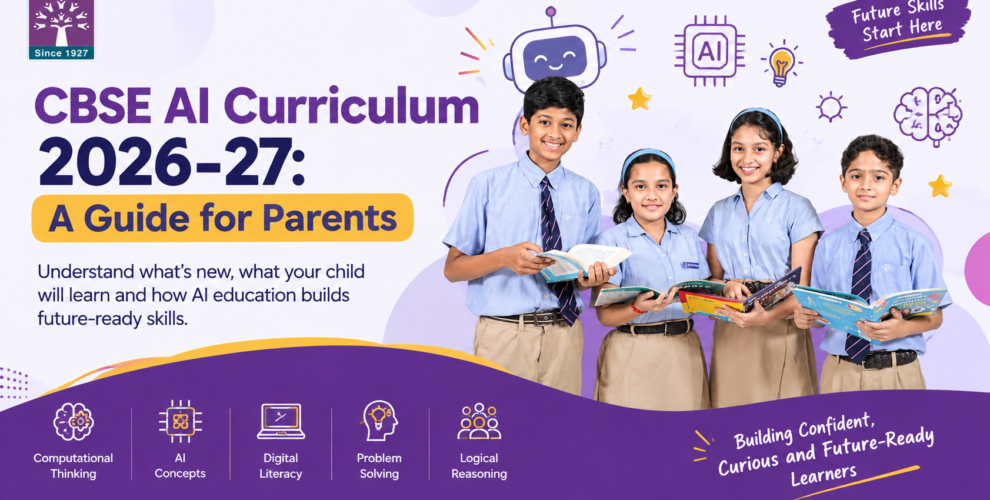
The CBSE framework covers Classes III–VIII for digital learning in schools and introduces children to concepts that prepare them for an increasingly technology-driven world and .
It brings together:
- Computational Thinking – learning to approach problems step by step.
- Artificial Intelligence – understanding where AI is used and what it can and cannot do.
- Digital Literacy – using technology thoughtfully and effectively.
- Problem-Solving – finding practical ways to overcome challenges.
- Logical Thinking – understanding patterns, sequences and relationships.
The goal is not to turn every child into a programmer. It is to develop AI-ready learners who can think, question and solve problems confidently.
Why Has CBSE Introduced AI Education in Schools?
Why does a child need to understand AI so early?
Children are growing up surrounded by technology. From voice assistants and recommendation systems to smart devices, AI is already part of everyday life.
Therefore, children need more than the ability to operate technology. They need to learn how to question, analyse and use it responsibly.
The curriculum supports skills such as:
- Logical reasoning
- Creativity
- Problem-solving
- Critical thinking
- Digital literacy
- Ethical decision-making
These skills can help children become thoughtful users and future creators of technology.
What Will Children Learn in the AI Curriculum for Classes 3 to 8?
What will AI learning actually look like in the classroom?
The learning is designed to progress according to children’s age and developmental level.
Computational Thinking
How does computational thinking help children solve problems?
The CBSE AI curriculum introduces children to key computational thinking skills, including:
- Decomposition – breaking a big problem into smaller parts.
- Pattern Recognition – identifying patterns and similarities.
- Abstraction – focusing on important information.
- Algorithm Design – creating step-by-step solutions.
- Data Analysis – understanding and using information.
- Troubleshooting – finding and fixing mistakes.
These skills help children develop logical thinking, problem-solving and critical thinking.
Understanding Artificial Intelligence
Where does your child see AI in everyday life?
Children can begin recognising AI around them and understanding both its possibilities and limitations.
Problem-Solving Through Activities
Can children learn AI by doing rather than memorising?
Age-appropriate activities, projects and challenges can give children opportunities to apply logical thinking to real situations.
Responsible and Ethical Use of AI
Should children only learn what AI can do?
No. They also need to understand responsible technology use, thoughtful decision-making and the possible impact of AI.
What Is Computational Thinking and Why Does It Matter?
What does “computational thinking” really mean?
Imagine your child’s school bag is completely messy. Instead of trying to organise everything at once, your child could:
- Take everything out.
- Group similar items together.
- Decide where each item belongs.
- Follow a sequence to organise the bag.
That is structured problem-solving in action.
Computational thinking helps children develop skills such as decomposition, pattern recognition, abstraction, algorithm design, data analysis and troubleshooting.
How Will AI Education Benefit Children?
Will AI education replace traditional learning?
No. It complements foundational academic learning by helping children apply knowledge and strengthen their thinking skills.
It can support:
- Logical thinking
- Problem-solving
- Creativity
- Critical thinking
- Digital awareness
- Innovation
- Responsible technology habits
The bigger question is not simply, “Can my child use technology?” but “Can my child think effectively while using it?”
How Can Schools Make AI Learning Meaningful for Children?
How can schools make AI more than another theoretical subject?
Children learn best when they can explore and apply ideas. Schools can make AI learning engaging through:
- Hands-on activities
- Projects and experiments
- Group work
- Problem-solving exercises
- Digital tools
- Cross-subject learning
At Greater Noida Podar Learn School, the Explore–Experience–Implement approach creates opportunities for children to connect classroom learning with practical experiences.
How Can Parents Prepare Children for AI Education at Home?
Do parents need to enrol their children in expensive AI courses?
Not necessarily. Everyday activities can encourage the same thinking skills.
Parents can:
- Encourage children to ask “Why?” and “How?”
- Introduce puzzles and logic-based games.
- Help children divide large problems into smaller steps.
- Point out examples of AI in everyday life.
- Discuss responsible and thoughtful technology use.
Small conversations today can build valuable thinking habits for tomorrow.
AI Education Is About Teaching Children to Think, Not Just Use Technology
So, what is the real purpose of the CBSE AI curriculum 2026-27?
It is much bigger than learning about artificial intelligence. It is about helping children think logically, solve problems, recognise patterns, question information and use technology responsibly.
The future will not simply belong to children who know how to use technology. It will belong to those who know how to think with it, question it and use it wisely.
At Greater Noida Podar Learn School, learning goes beyond textbooks. We combine strong academic foundations with practical, technology-enabled and skill-focused learning to help children prepare for tomorrow.
Want to see how this approach comes alive in the classroom? Visit our school and experience our learner-centric learning environment firsthand.