

Why Parents in 2026 Prefer Skill-Based Education Over Rote Learning
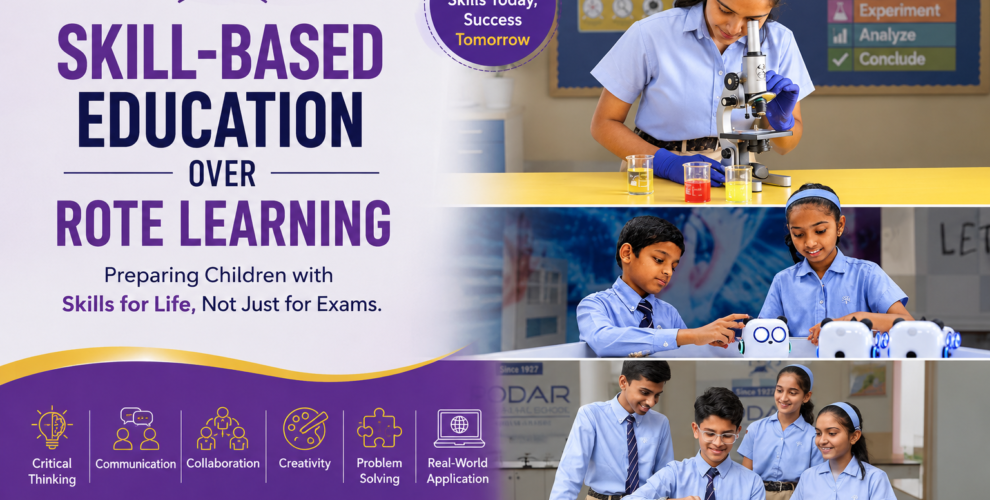
Introduction — Is Memorising Enough for Today’s Children?
Imagine this: your child scores full marks in a science test. A few days later, you ask them to explain the same concept in their own words—and they struggle.
Or perhaps your child can solve a maths problem exactly as it appears in the textbook but finds it difficult to use the same concept in real life.
As a parent, what would matter more: your child remembering the answer or truly understanding how to use it?
In 2026, many parents are asking questions beyond marks: Can my child communicate confidently? Can they solve problems independently? Can they apply what they learn?
As parents look beyond marks and focus on the skills children need for life, skill-based education is becoming more important than ever.
Education should not stop at “What did my child learn?” It should also answer, “What can my child do with what they learned?”
What Is Skill-Based Education?
Skill-based education focuses on helping children understand, practise and apply what they learn instead of simply memorising information. It includes activities, experiments, projects and play-based learning that make learning more active and engaging.
It includes:
- Learning by doing: Activities, experiments and projects make learning active.
- Critical thinking: Children learn to question, analyse and form their own ideas.
- Problem-solving: Students learn to find solutions to real or classroom problems.
- Communication: Discussions, presentations and storytelling help children express themselves.
- Creativity: Projects and open-ended activities encourage children to think differently.
- Collaboration: Group activities teach children to listen, cooperate and share responsibilities.
- Practical application: Students connect classroom concepts with everyday situations.
For example, instead of only memorising parts of a plant, students could grow a seed and observe its changes. In mathematics, they could run a mini classroom shop, calculate prices and practise giving change. The purpose is not to replace textbooks. It is to help children understand why they are learning something and how they can use it.
Skill-Based Education vs Rote Learning: What Is the Difference?
Rote learning is not completely useless. Children need to remember vocabulary, multiplication tables, facts and formulas. However, remembering is only one part of learning.
| Skill-Based Education | Rote Learning |
| Focuses on understanding | Focuses mainly on memorization |
| Encourages application | Focuses on recalling information |
| Develops problem-solving | Primarily tests recall |
| Encourages curiosity | May encourage one-way learning |
For example, instead of asking children to memorise which objects float or sink, a teacher might ask, “Which objects do you think will float—and why?” Students can predict, test and discuss their observations.
That is learning beyond memorisation.
Why Are Parents Choosing Skill-Based Education in 2026?
1. Children Learn by Doing
Children often remember experiences better than information they simply read. A science experiment, model or classroom activity can make a concept meaningful and memorable.
2. It Builds Confidence
When children regularly speak, present ideas and participate in activities, they gradually become more comfortable expressing themselves. A shy child may find confidence while explaining a project to classmates.
3. It Encourages Critical Thinking
Instead of always asking, “What is the correct answer?”, teachers can ask, “What do you think?” For example, students can identify unnecessary paper waste in school and suggest ways to reduce it.
4. It Connects School Learning With Real Life
Mathematics can be connected to shopping and budgeting. Language skills can be used in speeches and conversations. Science can be explored through experiments. Learning becomes relevant, not just examinable.
5. It Prepares Children for a Changing Future
Children need to communicate, collaborate, adapt and solve unfamiliar problems. Group projects can teach them to listen to others, divide responsibilities and work towards a common goal.
Does Skill-Based Education Mean Academics Are Less Important?
Not at all. Academic knowledge remains essential. Skill-based education helps children understand and use that knowledge more effectively. A balanced approach can include:
- Strong academic foundations through curriculum-based learning.
- Conceptual understanding instead of memorising without understanding.
- Practical application through activities and real-life situations.
- Communication and collaboration through discussions and group work.
- Problem-solving by applying knowledge to new situations.
- Meaningful assessment that considers understanding as well as recall.
For example, students may first learn the formulas for measurement and then use a measuring tape to measure classroom objects. The goal is not fewer academics. The goal is better engagement with academics.
How Skill-Based Learning Helps Children Beyond the Classroom?
What happens when a child’s science experiment does not work? Instead of giving up, they can ask, “What went wrong?” That simple moment can develop curiosity, resilience and problem-solving. Skill-based learning can help children develop:
- Confidence and independence
- Communication skills
- Creativity and curiosity
- Teamwork and collaboration
- Decision-making
- Critical thinking
- Problem-solving
- Responsibility and resilience
These skills can help children become confident learners and capable individuals.
What Should Parents Look for in a Skill-Based School?
When choosing a school, parents can ask: “What does learning actually look like inside the classroom?” Parents can look for schools that:
- Provide activity-based and experiential learning.
- Offer projects and hands-on experiences.
- Encourage children to speak, present and communicate.
- Promote teamwork and collaboration.
- Encourage students to ask questions and share ideas.
- Give children opportunities to solve problems independently.
- Maintain a healthy balance between academics and practical learning.
- Use assessment to check understanding and application, not only memorisation.
Parents can also ask: “Can you give me an example of a recent classroom activity where students used what they learned?”
The answer can reveal whether skill-based learning is genuinely part of everyday classroom practice.
The Future of Education Is About More Than Marks
Marks will always matter—but they are only one part of a child’s educational journey.
The real purpose of education is to help children understand, question, communicate and apply what they learn.
That is why Skill-Based Education Over Rote Learning is becoming an important priority for parents.
So, perhaps the question is not only:
“How many marks did my child score?”
But also:
“Is my child learning how to think, solve and grow?”
At Greater Noida Podar Learn School, we believe education should build strong academic foundations while giving children meaningful opportunities to explore, express and apply their learning. Ready to explore learning beyond memorisation? Discover how Greater Noida Podar Learn School, can help your child learn with confidence, curiosity and real-world skills.